
Expand key insights ▾
- Semi-transparent stains are easier to refresh than solid ones.
- Clean first, then recoat only when the finish starts fading.
- A new coat holds up longer when loose boards and rails are fixed first, which is why a deck repair Charlotte NC visit often comes before restaining.
- Shaded decks need mildew control more than color alone.
- Deck stain and deck sealer are not the same product, and mixing them up shortens the life of both.
- Friends Enterprises handles deck staining Charlotte and deck repair Charlotte NC work in one visit instead of two separate contractors.
Table of Contents
- What stain type is easiest to maintain on a deck?
- How often should you clean and recoat a stained deck?
- Which stain finish holds up best in sun and shade?
- What mistakes shorten the life of outdoor wood stain?
- What's the difference between deck stain and deck sealer?
- How do you maintain a stained deck year-round?
- What is the best wood stain for outdoor decks?
- Is Cabot or Behr deck stain better?
- What is the best long-lasting stain for decking?
- Deck staining and repair services in Charlotte, NC
- Frequently Asked Questions
If you are looking into deck staining Charlotte NC options, or you already have a stained deck and want to know how to maintain a stained deck without redoing the whole thing every year, this guide covers both. How to maintain a stained deck comes down to three things: clean the surface, watch the wear points, and recoat before the finish fails. Homeowners searching for deck staining Charlotte tend to look this up right after the first summer, once fading shows up on the sunniest boards.
This guide breaks down the stain types that make maintenance simpler, the signs that tell you it is time for another coat, and the difference between deck stain and deck sealer, since the two get confused often. If your deck needs more than a fresh coat, that is usually a deck repair Charlotte NC job first and a staining job second. Friends Enterprises handles deck repair Charlotte NC work and deck staining Charlotte projects together, so loose boards and a tired finish get fixed in one visit instead of two.

Deck repair and staining completed by Friends Enterprises in Charlotte, NC.
What stain type is easiest to maintain on a deck?
For most decks, semi-transparent stain is the easiest to maintain. It lets the grain show, and when it fades, you can usually clean and recoat without heavy scraping. That makes it a practical middle ground for homeowners who want protection without a big reset every time.
Solid stain lasts longer in some cases, but it can build up and peel if it is not handled well. Clear stain or sealer keeps wood looking natural, but it usually needs more frequent attention because it gives less UV protection. Consumer testing also notes that stain type changes how long a wood staining job tends to hold up on a deck, with solid products often lasting longer than clear ones on exposed surfaces. Consumer Reports
- Semi-transparent: easiest to refresh
- Solid: better coverage, more prep later
- Clear: simplest look, least forgiving
Why semi-transparent is the maintenance favorite
It does not hide the wood completely, so wear is easier to spot. That helps you act before the surface turns gray or dry in patches.
When solid stain makes sense anyway
If your deck has older boards, patchy color, or past stain buildup, solid stain can cover more. The trade-off is that future maintenance can take more labor.
| Stain type | Maintenance | Best use |
|---|---|---|
| Semi-transparent | Easiest to refresh | Sound wood; grain visible |
| Solid | More prep later | Older boards; more coverage |
| Clear | Least forgiving | Natural look; more frequent care |
Check this out: See a full renovation project completed by Friends Enterprises, including the finish work that goes into a job like this.
How often should you clean and recoat a stained deck?
Clean a stained deck at least once a year, and check high-traffic spots more often. The boards near stairs, railings, grill areas, and sun-heavy sections usually fail first. If water stops beading and starts soaking in fast, the finish is already losing strength.
A good maintenance cycle is simple: sweep debris, wash off dirt and pollen, let the wood dry fully, then inspect for fading, cracking, or bare spots. On many decks, a light maintenance coat is better than waiting for the finish to break down. That is especially true in humid climates, where mildew can show up on shaded boards sooner than on a vertical fence.
Published deck care guides and testing both point to the same idea. Flat outdoor wood takes more punishment from water, sun, and foot traffic than vertical surfaces, so the maintenance schedule needs to be tighter. Consumer Reports
Signs it is time to recoat
- Water no longer beads on the surface
- Color looks washed out in patches
- Boards feel dry or rough after cleaning
- Mildew returns after washing
Why waiting too long costs more
Once the stain fails fully, cleaning is not enough. You may need heavier prep, spot repair, or full stripping before the next finish can bond well. At that point it is worth treating it as a deck repair Charlotte NC job rather than a simple recoat.
Which stain finish holds up best in sun and shade?
Sun exposure and shade create different problems. In full sun, UV damage is the big issue, so you want a stain that resists fading and color change. In shade, mildew and surface grime matter more, so the finish has to tolerate moisture and slow drying.
That means the best option is not the same for every deck. A covered porch may do fine with a finish chosen for mildew resistance, while an open deck needs stronger color retention. Testing guides from consumer publications also note that decks take the harshest beating because they collect water, dirt, and debris on a flat plane.
If you want the wood grain to stay visible, a penetrating semi-transparent product is often the safer maintenance choice. If the wood is already uneven or patched, a solid finish may hide more, but you should expect more prep work later.
Best fit for full sun
Look for stronger UV resistance and plan on inspecting the finish more often. South-facing decks usually age faster than shaded ones.
Best fit for shade
Choose a product and care routine that fight mildew. Washoff alone is not enough if the boards stay damp for long periods.
Also read: Planning more than one project this year? Our kitchen remodeling Charlotte NC guide covers how bundled projects typically get scheduled.
What mistakes shorten the life of outdoor wood stain?
The biggest mistake is staining over dirty or damp wood. The second is waiting too long between coats. Both can cause the new finish to bond poorly and wear out faster than it should.
Another common problem is using the wrong product for the board's condition. Old decks with raised grain, cracks, or previous coating failure may need repair before staining, not just another coat. A finish cannot fix soft wood, rotten spots, or loose fasteners.
There is also a trade-off people do not love hearing: more opaque stains often buy more coverage, but they can cost you easier maintenance later. If you want a low-drama upkeep cycle, the right prep matters as much as the wood staining product itself.
What's the difference between deck stain and deck sealer?
Deck stain and deck sealer solve different problems, and mixing them up is one of the more common maintenance mistakes homeowners make. Deck stain adds color and some UV protection while still letting the wood grain show through, especially with semi-transparent formulas. Deck sealer is usually clear, and its main job is blocking water rather than changing how the wood looks.
Some products combine both functions in one can, which is where the confusion starts. A stain-sealer combo gives you color plus water resistance in a single application, while a standalone sealer is often used over bare or already-stained wood that just needs extra water protection without a color change.
For most Charlotte decks, a quality semi-transparent stain with built-in water resistance covers both needs at once. If your deck already looks the color you want and just needs protection, a clear sealer coat can extend the life of the existing stain without a full recoat.
- Stain: adds color, some UV protection, lets grain show
- Sealer: mostly clear, blocks water, little color change
- Stain-sealer combo: color plus water resistance in one product
- Best for most Charlotte decks: a stain with built-in water resistance
If you are not sure which one your deck needs, Friends Enterprises' stain work starts with a look at the current finish before recommending stain, sealer, or a combination product.
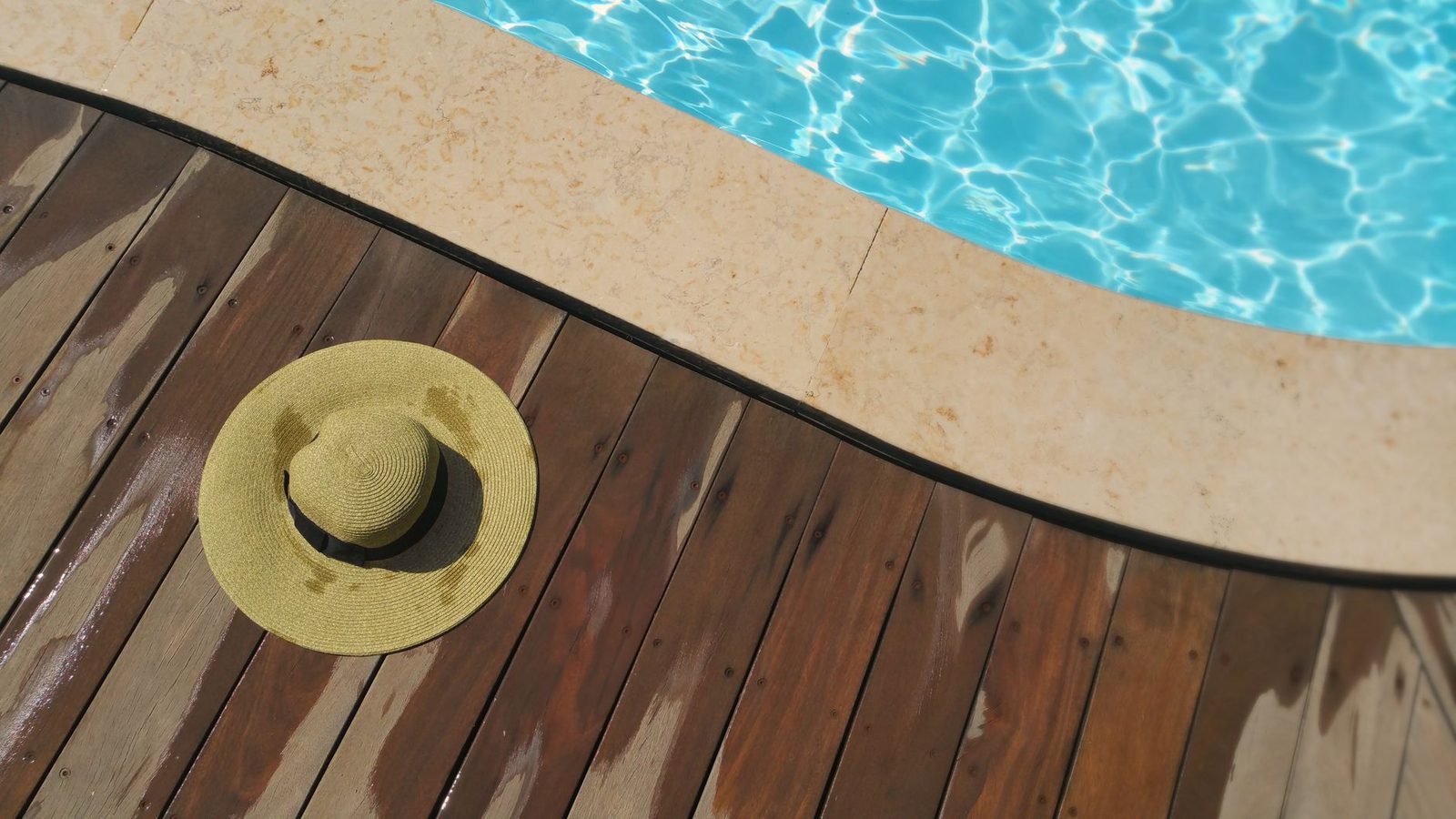
A straw hat rests on a wooden deck beside a sparkling blue swimming pool, perfect for summer relaxation. Photo: Pixabay / Pexels
Check this out: Curious who's doing the work? Learn more about Friends Enterprises and the crew behind the finish.
How do you maintain a stained deck year-round?
Year-round maintenance is mostly about staying ahead of buildup. Keep leaves and dirt off the boards, rinse spills quickly, and clear gaps where moisture gets trapped. On a deck, trapped debris behaves like sandpaper plus moisture, which is bad for any finish.
It also helps to protect the surface from the outside in. Trim nearby plants so airflow improves, move planters and furniture once in a while, and check the underside and steps for early wear. If the deck is part of a larger exterior project, it can make sense to pair staining with exterior painting or power washing so the whole surface gets reset together.
For Charlotte homeowners, that kind of bundled approach can save time when the deck is one piece of a bigger home-improvement list. Friends Enterprises also works on exterior painting, power washing, and wallpaper removal, so the same visit can cover more than one exterior or interior task. If the deck is part of a larger update, our general contractor overview covers how that bundling usually works.
Simple year-round habits
- Sweep off leaves and pollen
- Move furniture to avoid wear rings
- Rinse spills before they set
- Check rail caps and stairs after storms
When to bring in a pro
If the stain is patchy, the boards are splitting, or the deck has soft spots, a pro can tell you whether a deck repair Charlotte NC visit or a simple restain comes first.
What is the best wood stain for outdoor decks?
For most outdoor decks, the best choice is a penetrating semi-transparent stain made for exterior wood. It usually gives the best mix of color, water resistance, and easier upkeep. It soaks into the wood instead of sitting like a thick film, which helps it wear more naturally over time.
If your main goal is long service life with less fuss, look for a product designed for decks and other weather-exposed surfaces, not an interior stain repackaged for outside use. Good exterior wood staining products are made to handle sunlight, moisture, and foot traffic. That matters more than picking the darkest color or the newest label.
There is no single perfect answer for every deck because wood type, age, and past coatings all affect results. Newer pressure-treated lumber often does well with semi-transparent formulas. Older decks that have gone gray or have patchy color may need cleaning, prep, and possibly a more forgiving stain choice before you get a smooth finish.
Consumer guidance also points to stains that balance durability and appearance, especially when you want protection without heavy buildup. Consumer Reports notes that several major brands can perform well when matched to the right job. The real key is less about hype and more about choosing a stain that fits your deck's condition and your willingness to maintain it.
If you want the shortest path to a better result, start with the deck itself. Clean wood, solid boards, and proper prep usually do more for longevity than chasing the most talked-about can on the shelf.
Also read: Wood is not the only surface that ages. See how Friends Enterprises approaches drywall repair when interior walls need the same kind of attention.
Is Cabot or Behr deck stain better?
Cabot and Behr can both be good, but the better choice depends on the deck, the climate, and how the product is used. One brand is not automatically better in every situation. What matters most is the type of stain, the wood condition, and whether the formula matches your local weather and sun exposure.
In general, deck stains fall into a few buckets: clear, semi-transparent, semi-solid, and solid. That choice often matters more than the name on the label. A good semi-transparent stain may be ideal for a newer deck where you want the grain to show. A semi-solid or solid stain may be smarter if the surface has uneven color, older repairs, or more wear.
When comparing brands, check how they handle UV protection, water repellency, and recoat timing. Also look at whether the stain is easy to prep for next time. Some products are more forgiving on weathered wood, while others need a very clean, very even surface to look right.
Home Depot's buying guide explains that exterior wood stains differ in transparency, base type, and durability, which changes how they perform in real use. That is why brand comparisons are helpful, but only after you decide what your deck actually needs. Home Depot lays out these differences clearly for homeowners trying to narrow the field.
If you are stuck between two brands, choose the one that best matches your deck prep level, the finish you want, and the upkeep you can realistically handle. That is usually the smarter call than chasing a winner by brand name alone.
What is the best long-lasting stain for decking?
The longest-lasting deck stain is usually a high-quality penetrating exterior stain that fits the wood and the weather, not the thickest coating you can find. In many cases, semi-transparent and semi-solid stains hold up better in the long run because they wear gradually instead of peeling in sheets.
For durability, look for three things: strong UV resistance, good water shedding, and ease of maintenance. A stain that is easy to refresh often lasts longer in practical terms because you can recoat it before the deck starts to fail. That keeps the wood protected and reduces the chance of costly repairs later.
Decks in full sun often need a more robust formula than shaded decks, especially if the boards get hot and dry out fast. Shaded decks face a different challenge: moisture, mildew, and slower drying times. The best long-lasting option is the one that answers the main threat on your property.
For homeowners who want a dependable next step, the product choice is only half the job. Proper cleaning, drying time, and even application have a huge effect on how long the stain actually lasts. A great stain on poorly prepared wood will still fail early.
If you want the simplest path from question to action, this is where a pro can help. Friends Enterprises can assess the deck condition, recommend the right stain type, and handle the prep and application so you get a finish that lasts as long as it should. That means less guesswork and a better result from the start.
Deck staining and repair services in Charlotte, NC
Not every deck problem is really about the stain. If boards are soft, rails are wobbly, or fasteners are pulling loose, a deck repair Charlotte NC visit needs to happen before any new finish goes on. Friends Enterprises handles both sides of the job: carpentry repairs to fix what is damaged, then deck staining Charlotte homeowners can expect to hold up through the next few Carolina summers.
Homeowners comparing Charlotte deck builders for a brand-new structure and homeowners who just need an existing deck repaired and restained are usually looking for different things. Builders handle new construction from the ground up. Friends Enterprises focuses on keeping the deck you already have safe, solid, and freshly finished, which is the more common need once a deck is a few years old.
A typical deck staining Charlotte NC visit can include:
- Pressure washing to strip dirt, mildew, and old finish residue, via our power washing service
- Carpentry repairs for loose boards, rails, and stairs, through our carpentry repairs service
- Full wood deck repair and staining scheduled in one visit
- Stain work matched to your deck's sun and shade exposure, from our stain work service


Deck cleaning and staining project completed by Friends Enterprises in Charlotte, NC.
For Charlotte homeowners who also need interior painting, cabinet painting, or remodeling help, it is often easier to work with one contractor who covers the full services list at once. Friends Enterprises does that kind of cross-scope work, which can help when the deck is part of a larger home update. You can also browse completed projects to see the kind of finish quality to expect.
Short answer
For most well-kept decks, semi-transparent stain is the most practical balance of looks and upkeep.
Shorter answer for rough decks
If the surface is worn, cracked, or blotchy, a deck repair Charlotte NC visit comes first, and the finish gets chosen based on how much coverage the wood needs after that.
Check this out: Browse the full guide library for more repair-vs-replace breakdowns like this one.
What is the best wood stain for outdoor decks?
What's the difference between deck stain and deck sealer?
What is the #1 deck stain?
Is Cabot or Behr deck stain better?
What is the best long-lasting stain for decking?
How do you know when a stained deck needs another coat?
How much does deck repair cost in Charlotte, NC?
Do I need Charlotte deck builders or a repair contractor?
More project guides: paint vs. replace cabinets, drywall repair vs. replace, and garage floor epoxy vs. paint.